Small Constraints • Big Follow-through
Red = Exposure / Burnout Green = Containment / Repetition

Why 15 Minutes Beats 3 Hours
(The Psychology of Small Constraints)

How decision fatigue, emotional exposure, and time boundaries determine whether decluttering sticks.
A tidy workspace with a small pile of items being sorted
15 min: contained 3 hrs: exposed Same goal. Different architecture.
A close-up of a kitchen timer set for fifteen minutes
timer = boundary Ends safely → returns tomorrow.
Section 1

The Exposure Problem

Failure is structural, not personal.
🔴 The 3-Hour Session Long exposure
1
Open entire closetScope explodes immediately.
2
Everything demands a decisionEvery item wants a trial.
3
Emotional exposure spikesMemories show up uninvited.
4
Justification fatigue“But what if…” becomes a loop.
5
Decision quality dropsClarity turns into bargaining.
6
Shove / stall / abandonReset happens… again.
The longer you stay in declutter mode, the more objects demand justification.
🟢 The 15-Minute Constraint Safe boundary
1
Open one shelfSmall target. Clear edges.
2
Limited exposureFewer memories at the mic.
3
Limited decisionsChoice stays manageable.
4
Instinct over negotiationYou respond. You don’t litigate.
5
Timer ends safelyExit while you’re still “okay.”
6
Repeat tomorrowReps beat heroics.
Fifteen minutes shuts the interrogation down.
Why this works
  • Reframes “failure” as structural, not personal.
  • Removes shame → increases follow-through.
  • Decreases blame → increases shareability.
Section 2

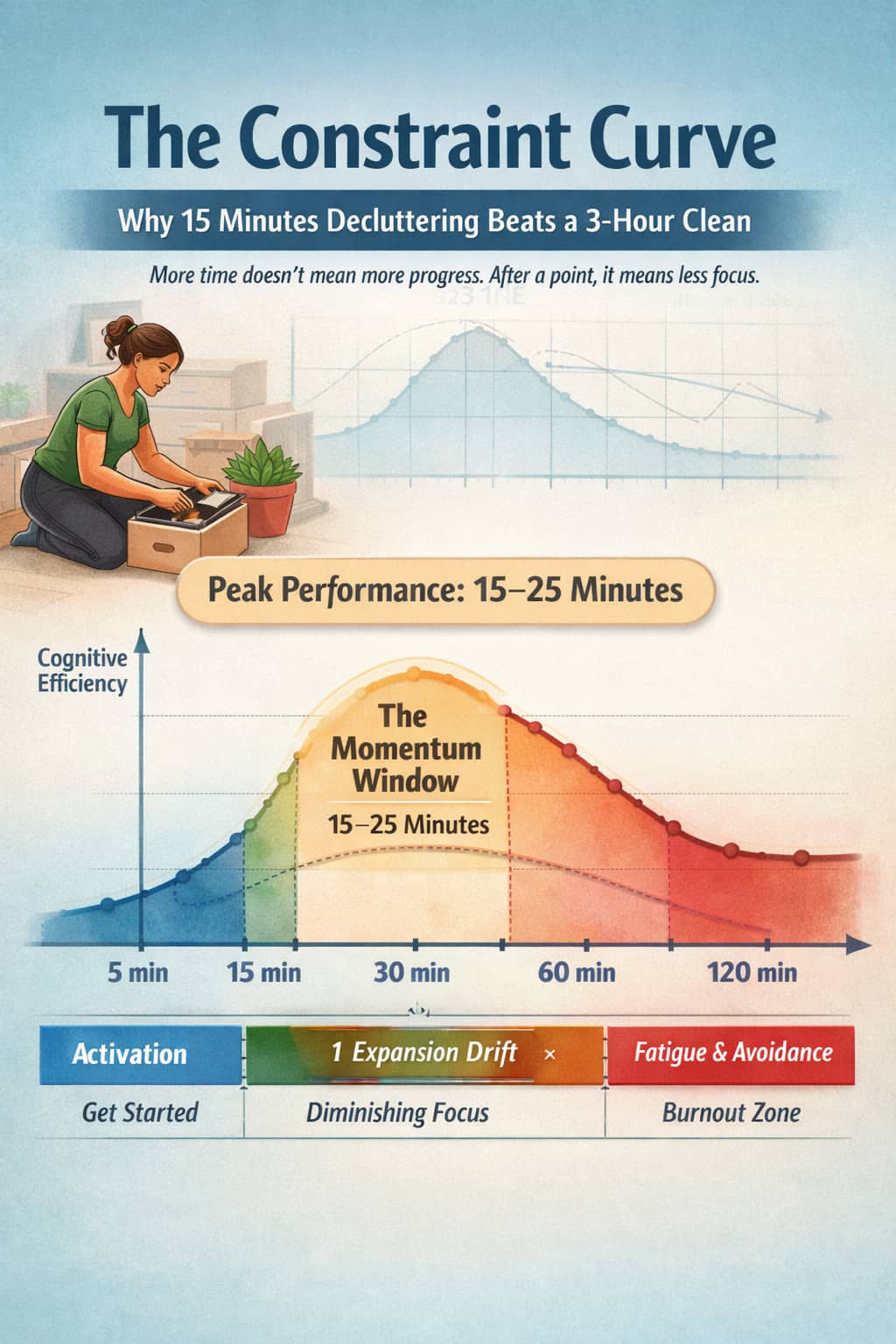
The Decision Fatigue Curve

Long exposure → justification loops.
Cognitive load
Time
3-hour session
15-minute constraint
Caption: Long exposure increases justification loops. Short exposure protects clarity.
When time is scarce, you stop negotiating with objects and start responding instinctively.
Section 3

Stopping On Time Is The Whole Point

Ending with energy builds trust.
Long session 100% → 0%
Result: decision quality collapses near the end.
After: recovery period before you can face it again.
15-minute constraint 100% → 70%
Key insight: you end while you still feel capable.
Effect: tomorrow feels approachable, not punishing.
Stopping on time preserves decision quality and minimizes resistance to the next session.
Section 4

Progress Shows Up in Friction, Not Photos

The first wins are invisible.
What You Expect Photos
!
Dramatic reveal
!
Empty rooms
!
Before/after contrast
What Actually Changes First Friction
Drawers close easier
Counters reset faster
Morning routines lose friction
Less irritation when reaching for items
If it feels easier to reset, it’s working — even before it looks “post-worthy.”
Section 5

Intensity Feels Powerful. Repetition Is Powerful.

Consistency removes motivation.
Calendar of small wins
Green checks stack
1
2
3
4
5
6
7
8
9
10
11
12
13
14
15
16
17
18
19
20
21
You don’t transform your house. You reduce weight daily.
Consistency removes motivation from the equation — the timer does the driving.