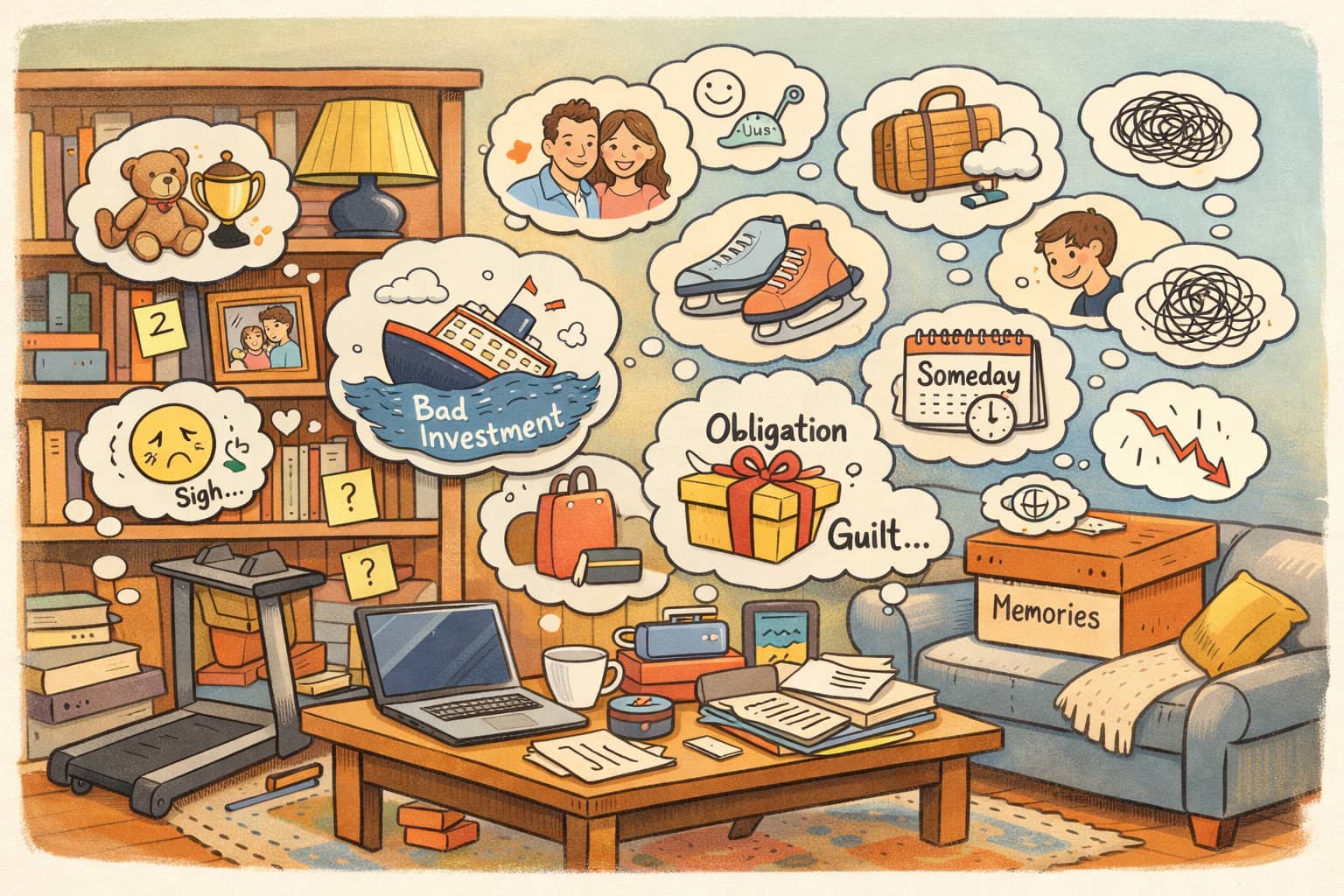
It’s not just taking up space. It’s taking up mental bandwidth.

Most clutter isn’t physical. It’s emotional — and emotional clutter has cognitive costs.

Higher home “clutter/disorganization” signals are linked with less healthy daily cortisol patterns in women.1

Decision fatigue is a documented pattern where repeated choosing can reduce follow-through and self-control resources across tasks.2

Visual clutter changes how attention and information flow are handled by the brain in complex scenes.3

What you think vs. the hidden cost

Each item feels protective on the left — but quietly charges a fee on the right.

Protection story (warm)
Hidden cost (cool)

Sentimental items

“I keep it because it’s meaningful.”

  • Emotional reasoning: connection, comfort, continuity
  • What it promises: “If I keep this, I keep the feeling.”

Hidden cost

  • Repeated grief activation
  • Emotional avoidance loop
  • Stored unresolved emotion

Every sighting reactivates a memory network — and that reactivation consumes cognitive energy.
Expensive mistakes

“I can’t throw it away — it was expensive.”

  • Emotional reasoning: fairness, “getting my money’s worth”
  • What it promises: “Keeping it cancels the mistake.”

Hidden cost

  • Sunk cost fallacy reinforcement
  • Subconscious shame trigger
  • Ongoing reminder of regret

Psychological mechanism: loss aversion

The “price tag” stays attached in your mind — even after the receipt is gone.

“Someday” items

“I might need it.”

  • Emotional reasoning: preparedness, security
  • What it promises: “Future me will be grateful.”

Hidden cost

  • Future-self anxiety
  • Delayed decision fatigue
  • Physical space crowding current goals

Micro-label: possible selves theory

Keeping “options” can become a full-time job your present life didn’t apply for.

Gifts you never liked

“It would be rude to get rid of it.”

  • Emotional reasoning: loyalty, politeness, guilt avoidance
  • What it promises: “Keeping it proves I’m grateful.”

Hidden cost

  • Guilt storage
  • Identity misalignment
  • Inauthentic environment cues

You are managing someone else’s feelings long after the moment has passed.

Legacy & heirlooms

“It’s part of my family history.”

  • Emotional reasoning: duty, belonging, continuity
  • What it promises: “Keeping it keeps the story safe.”

Hidden cost

  • Obligation weight
  • Fear-based preservation
  • Avoided identity evolution

You can honor a story without storing the object.

“Memory boxes”

“It helps me remember.”

  • Emotional reasoning: nostalgia, fear of forgetting
  • What it promises: “The object will hold the memory for me.”

Hidden cost

  • Outsourced memory reliance
  • Emotional backlog
  • Decision paralysis during review

Clutter competes for attention — the brain keeps processing what’s “around,” even when you’re trying to focus.3

The invisible price tag

Emotional clutter doesn’t just preserve the past. It taxes the present.

Reduced focus Elevated stress baseline Slower cleaning routines Less usable space Delayed life transitions Reinforced past identity Lower perceived control
  • Reduced focus (attention gets split)
  • Elevated stress baseline (your body stays “on”)
  • Slower routines (cleaning takes longer)
  • Less usable space (your home shrinks)
  • Delayed transitions (moves, changes, upgrades)
  • Reinforced past identity (stuck roles)
  • Lower perceived control (“I can’t get ahead”)

“You are paying rent for unresolved feelings.”

Instead of asking “Should I keep it?”

Ask questions that separate memory from avoidance — and identity from obligation.

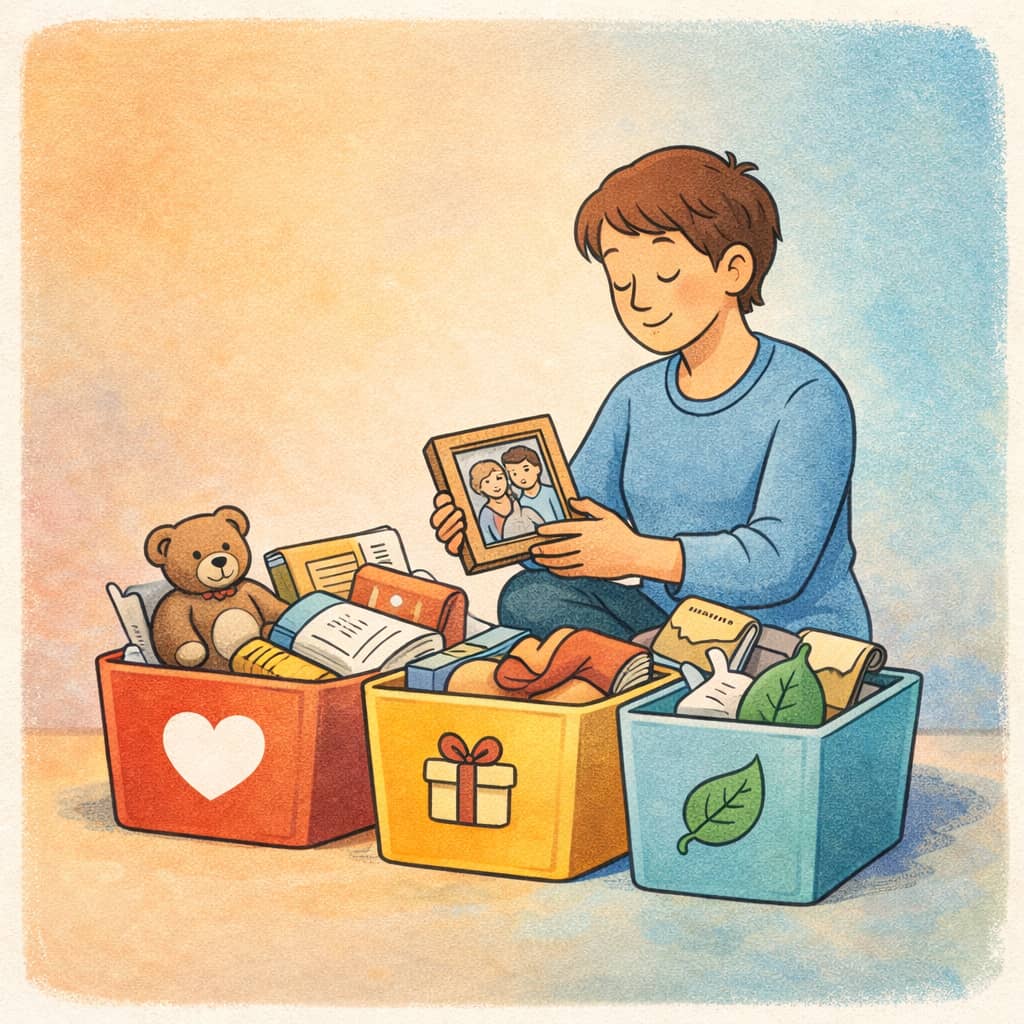
A friendly illustration of someone gently sorting a small pile into ‘keep’, ‘share’, and ‘release’ with a calm expression.
  1. Is this honoring the memory — or avoiding a feeling? If it stings every time, it may be asking for grief, not storage.
  2. Does this reflect who I am now? Your home is a daily mirror. Make it current.
  3. If this disappeared, what would actually change? Often the story stays — even when the object goes.
  4. Is this object adding energy — or extracting it? Some items cost you attention every time you walk past.

It’s not the object. It’s the identity attached to it.