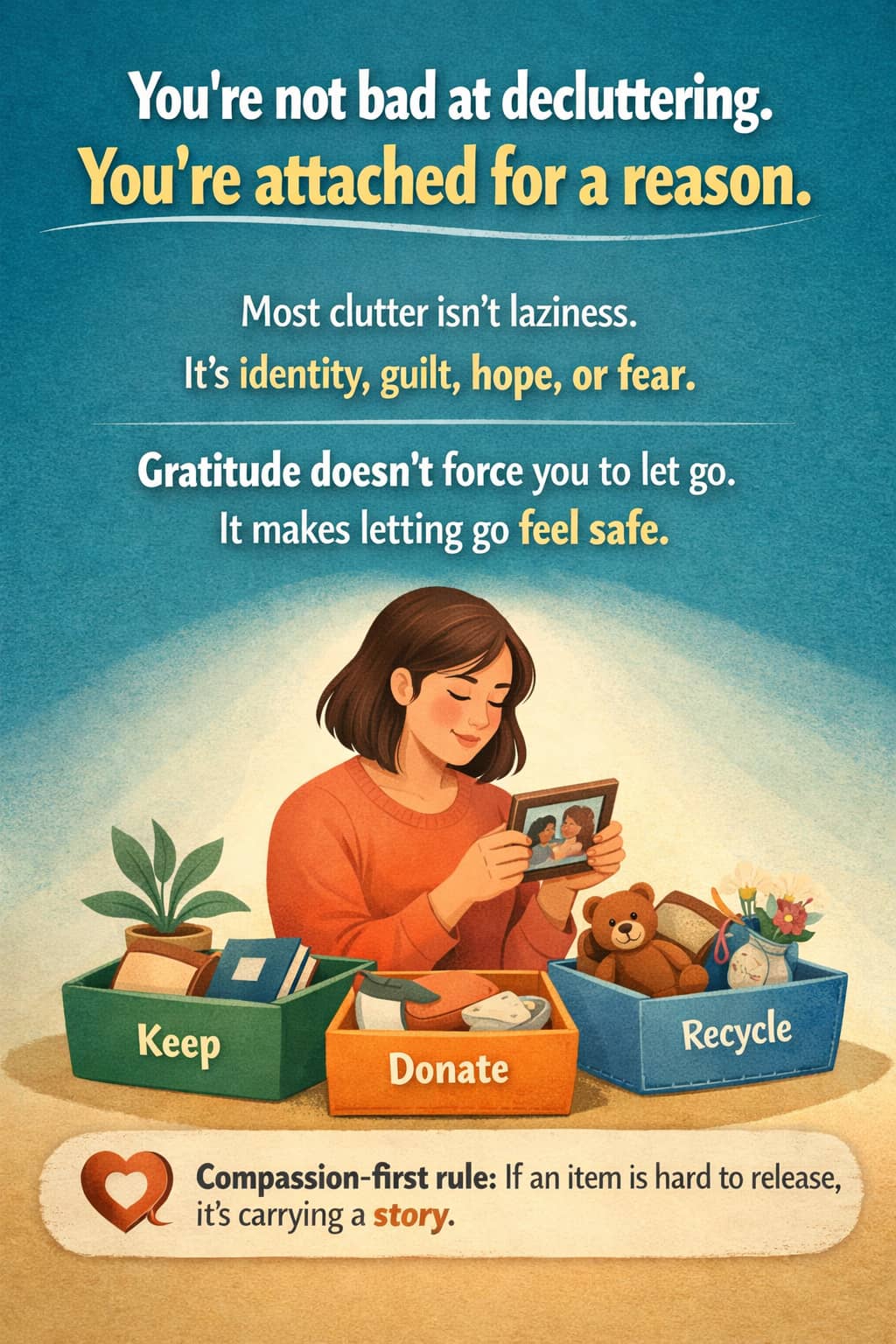
You’re not bad at decluttering. You’re attached for a reason.
Most clutter isn’t laziness. It’s identity, guilt, hope, or fear.
Gratitude doesn’t force you to let go. It makes letting go feel safe.
Compassion-first rule: if an item is hard to release, it’s carrying a story.
1) Identity Clutter
“The Old Me” items
Examples
- Clothes that fit a past version of your body
- Career materials from a previous path
- Hobby supplies you’ve outgrown
- Old awards, trophies, certificates
Why it stays
You’re not holding the item. You’re holding the identity.
What it sounds like internally
- “What if I go back to that?”
- “This used to be me.”
- “I worked hard for this.”
Gratitude reframe
Instead of
“I’m losing this version of me.”
It becomes
“This version of me got me here.”
Release script
“Thank you for representing who I was. I’m allowed to grow.”
Why it resonates: emotionally validating, therapy-adjacent language.
2) Guilt Clutter
“Someone Gave This to Me” items
Examples
- Unused gifts
- Family heirlooms you don’t love
- Expensive items you regret buying
- Handmade things you don’t use
Why it stays
You confuse the object with the relationship.
What it sounds like internally
- “They’ll be hurt.”
- “I should use this.”
- “It was expensive.”
Gratitude reframe
Instead of
“I’m disrespecting them.”
It becomes
“I’m honoring the thought, not the object.”
Release script
“I’m grateful they thought of me. The love isn’t in the item.”
Why it resonates: a hidden pain point that sparks comments and tagging.
3) Aspirational Clutter
“The Future Me” items
Examples
- Workout gear never used
- Books you “should” read
- Craft supplies
- Kitchen gadgets for meals you don’t cook
Why it stays
It represents hope, discipline, or fantasy.
What it sounds like internally
- “One day I’ll use it.”
- “This is who I want to be.”
- “I just need more motivation.”
Gratitude reframe
Instead of
“I failed.”
It becomes
“This showed me what I thought I wanted.”
Release script
“Thank you for showing me who I’m becoming — or not.”
Why it resonates: deep self-recognition for lifestyle and self-development audiences.
4) Scarcity Clutter
“Just in Case” items
Examples
- Duplicates
- Broken items saved for parts
- Old cords and manuals
- Backup everything
Why it stays
It’s fear disguised as preparedness.
What it sounds like internally
- “What if I need this?”
- “It’s wasteful to throw away.”
- “I might regret it.”
Gratitude reframe
Instead of
“I might not have enough.”
It becomes
“I have enough now.”
Release script
“I trust myself to handle future problems.”
Why it resonates: anxiety-based accumulation with strong minimalist crossover.
Clutter isn’t about stuff. It’s about emotion.
| Clutter Type | What It’s Really About |
|---|---|
| Identity | Change |
| Guilt | Obligation |
| Aspirational | Self-judgment |
| Scarcity | Fear |
Tiny truth: when the emotion is named, the pile shrinks.
Gratitude completes the story.
When an item’s purpose is acknowledged, it no longer needs to stay to prove it mattered.
Acknowledge the meaning. Keep the lesson. Release the object.
- Name what the item represents.
- Thank it for the role it played.
- Choose what supports your life now.