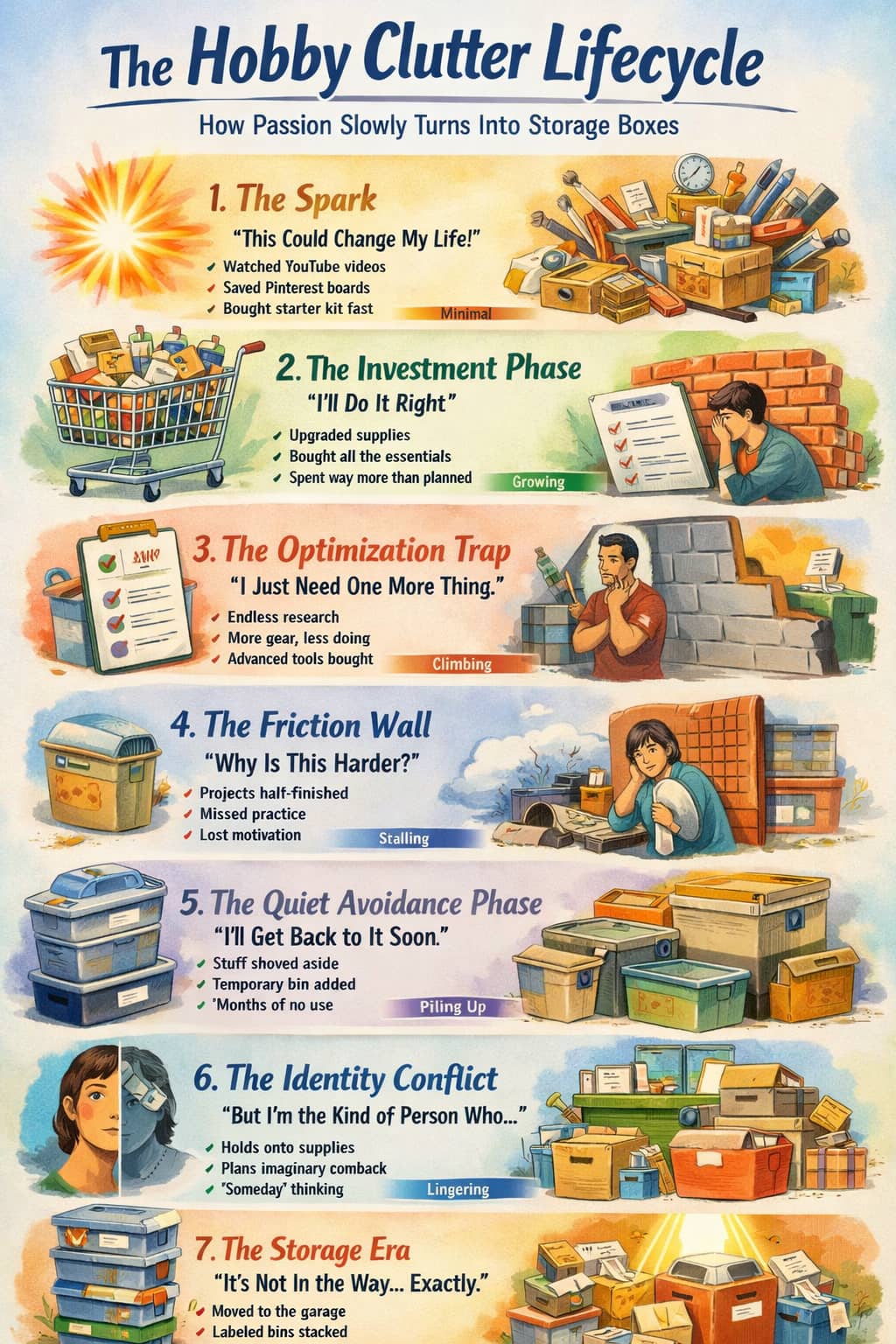
The loop, flattened into a journey
Most hobby clutter doesn’t arrive all at once. It arrives in stages—each one emotionally reasonable, each one physically louder.
- Start: excitement and possibility.
- Middle: preparation replaces practice.
- End: storage becomes the “solution” until decluttering forces a decision.
Micro-stats below are common self-report ranges and household patterns—useful for context, not a diagnosis.
Micro-stats people recognize
Drop-off window
60–80% of hobby starts taper off within the first year.
Spending burst
Many purchases cluster in the first 30 days.
Space footprint
An abandoned hobby often occupies 2–8 sq ft of storage.
Why it sticks
People are often ~3× more likely to keep items tied to an aspirational identity.
The 8 stages
The Spark
“This Could Change My Life.”
Excitement + identity expansion
- Watches 3–10 YouTube videos
- Saves Pinterest boards
- Tells friends about the new hobby
- Buys a starter kit within 48 hours
Clutter impact: 1–3 new items enter the home. Zero friction yet.
Psychology Dopamine spike from possibility
The Investment Phase
“If I’m Going to Do This, I’ll Do It Right.”
Justified spending
- Upgrades beginner tools
- Buys organizational storage
- Orders “recommended essentials”
- Spends 2–5× the original budget
Clutter impact: 1 dedicated shelf/drawer claimed. Packaging kept “just in case.”
Psychology Identity reinforcement through ownership
The Optimization Trap
“I Just Need One More Thing.”
Preparation over action
- Research outweighs practice
- Watches tutorials instead of doing
- Buys tools for the “advanced stage”
- Adds accessories to “remove friction”
Clutter impact: Tool count doubles. Materials accumulate unused.
Psychology Progress illusion (feels productive, isn’t)
The Friction Wall
“Why Is This Harder Than I Thought?”
Frustration + comparison
- Missed practice sessions
- Half-finished project appears
- Compares self to experts
- Decreased frequency
Clutter impact: Items sit out “mid-project.” Surfaces get consumed.
Psychology Expectation gap
The Quiet Avoidance Phase
“I’ll Get Back to It Soon.”
Low-grade guilt
- Supplies moved to a corner
- A “temporary” storage bin appears
- 30–90 days pass with no use
- Quick excuses replace calendar time
Clutter impact: 1–3 containers added. Visible → hidden migration begins.
Psychology Sunk cost denial
The Identity Conflict
“But I’m the Kind of Person Who…”
Attachment to future self
- Defends keeping supplies
- Mentally plans a restart
- Avoids calculating money spent
- Feels “wasteful” to let go
Clutter impact: Items survive multiple decluttering attempts. “Someday” label applied.
Psychology Aspirational identity preservation
The Storage Era
“It’s Not in the Way… Exactly.”
Justification
- Moved to garage / closet / basement
- Consolidated but not reduced
- Forgotten until moving or deep cleaning
- No use for 6–24 months
Clutter impact: 2–6 sq ft claimed. Quiet tax on space and attention.
Psychology Out-of-sight rationalization
The Decluttering Reckoning
“Why Am I Keeping This?”
Clarity + mild grief
Decision points
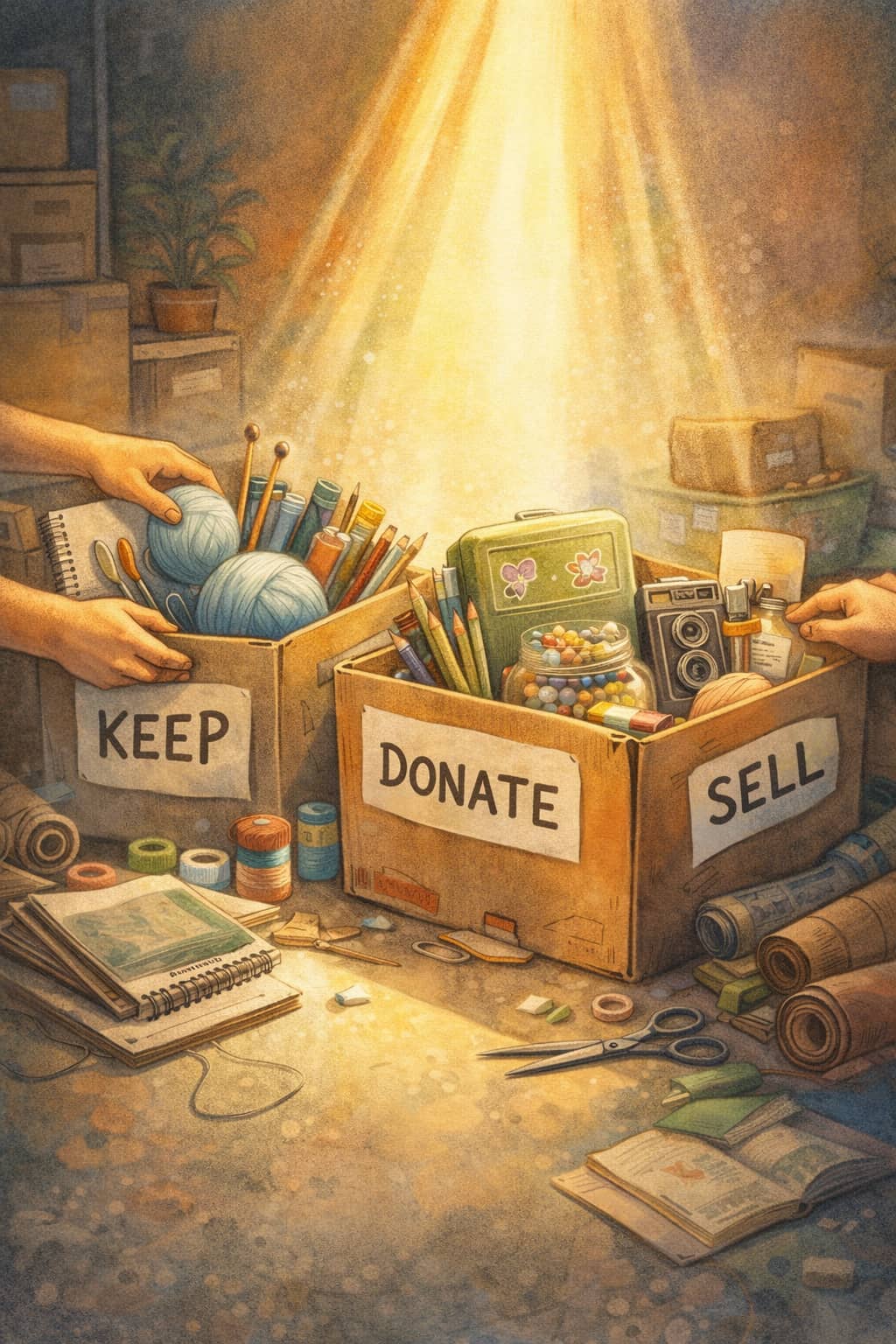
- Keep & recommit: choose a tiny, scheduled restart
- Sell: convert items back into options
- Donate: move supplies to someone who’s active
- Repurpose: keep only what serves today
- Release: let the future-self fantasy soften
Clutter impact: Space reclaimed. Emotional energy restored.
Psychology Identity recalibration
Why hobbies become clutter
- We buy identity before skill.
- We overestimate future time.
- We underestimate friction.
- We attach items to future selves.
- We mistake ownership for progress.
If you want the hobby back, shrink the restart. If you want the space back, release the identity debt.