
Why You Can’t Start Decluttering
The Hidden Psychology Behind Clutter Paralysis
It reads it as a bundle of threats: loss, regret, identity, and unfinished emotional business.
Starting Feels Harder Than Doing
It’s not the effort. It’s what your nervous system thinks the effort *means*.
| Decluttering task | Brain interprets as |
|---|---|
| Throwing away old items | Loss“If I let go, I can’t undo it.” |
| Sorting | High-stakes“This is a test of my judgment.” |
| Facing old purchases | Regret“Here’s proof I messed up.” |
| Clearing sentimental objects |
The 4 Invisible Friction Traps
These aren’t “bad habits.” They’re predictable distortions that make starting feel dangerous.
Trap #1: The “Fix My Whole Life” Illusion
Trap #2: Permanent Decisions
Trap #3: Open Loops
Trap #4: “Where Does This Go?”
The 5-Minute Reset Model
A starting method that sidesteps threat-meaning and lowers the decision temperature.
Pick one friction surface
Not a room. A desk corner. A counter strip. The chair that eats laundry.
Remove (don’t decide)
Pull everything off the surface into a temporary pile or bin.
Contain (don’t categorize)
Make quick containers: “Elsewhere,” “Trash,” “Return,” “Pause.”
Stop early (don’t optimize)
End on purpose. The win is the reset, not perfection.
What Actually Builds Momentum
Momentum comes from reducing decision load, not “finding motivation.”
…or it “doesn’t count.”
…and justify everything.
…before you have clarity.
…then wonder why it never shows up.
Small finish line. Fast reward.
Less debate, more relief.
Contain first. Organize later (optional).
Motivation follows the reset.
You’re Not Decluttering Objects. You’re Reducing Cognitive Load.
When your environment stops shouting “unfinished,” your brain can exhale.
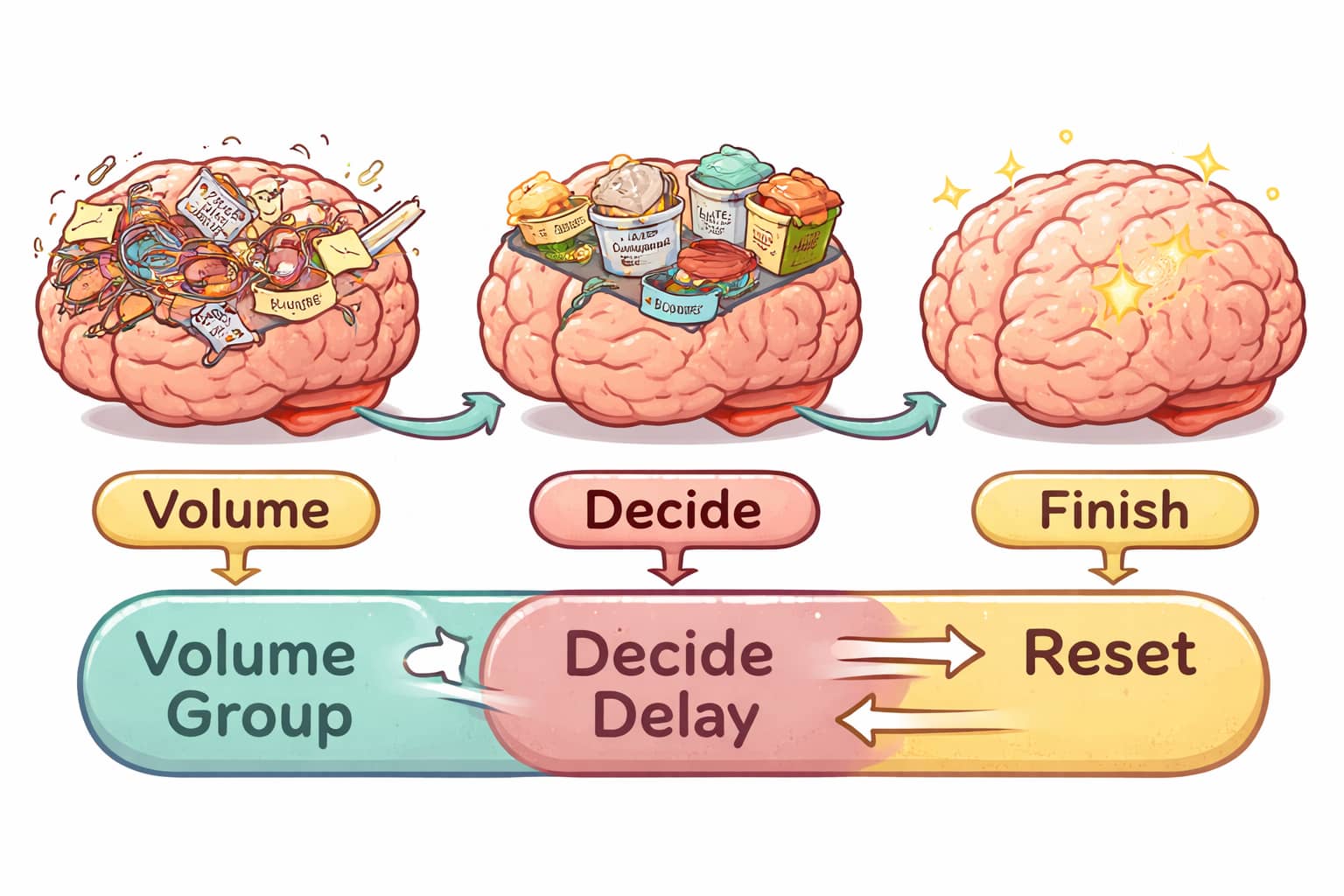
Layer 1: Volume → Group
Your first win is visual quiet: fewer piles, fewer “things yelling at you.”
Layer 2: Decide → Delay
You don’t need perfect answers now—just a safe “not yet” container.
Layer 3: Finish → Reset
A reset is complete by design—because it ends on time, not on perfection.