The Life Stage Decluttering Curve

How Clutter Evolves As We Age (And Why)

Clutter isn’t random It’s stage-specific It shifts with identity, income & space Attachment changes the rules
Most decluttering advice treats clutter as a personal failure. This reframes it as a predictable lifecycle pattern—so you can work with your season instead of fighting it.
A lived-in room with visible clutter that feels familiar, not shameful
Clutter is a phase… not a verdict.

One timeline. Four “clutter forces.”

Physical peaks in midlife. Emotional peaks later. Digital spikes early and stays high. Time drops right when you need it.

18–24 25–34 35–44 45–54 55–64 65+ DIGITAL stays high (photos, files, tabs) ATTACHMENT peaks later PHYSICAL peaks midlife TIME dips right when needed
Physical clutter volume Emotional attachment intensity Available time to declutter Digital clutter load
When clutter is highest, time is lowest. When time returns, attachment is highest.

Six stages. Four data points each.

Think of each stage like a “clutter climate.” You don’t blame the weather—you plan for it.

College & Early Independence

18–24
Most common clutter
  • Fast fashion
  • Dorm furniture
  • Cables & tech
  • Freebie items
  • Hobby experiments
Why it accumulates
Low income + high experimentation. Identity exploration often looks like “object sampling.”
Emotional driver
“Who am I becoming?” Objects become identity test runs.
Decluttering unlock
Transition mindset: “Not every version of me needs to come forward.”

Early Career & Apartment Years

25–34
Most common clutter
  • Duplicate kitchen items
  • Cheap furniture “upgrades”
  • Decor experiments
  • Subscription boxes
  • Digital clutter explosion (photos, files)
Why it accumulates
Rising income + unstable housing. Upgrade cycles happen faster than disposal cycles.
Emotional driver
“I should be further along.” Consumption becomes proof of progress.
Decluttering unlock
Acquisition → optimization: keep what supports your routine, not your wishlist-self.

Family Formation & Midlife Expansion

35–44
Most common clutter
  • Kids’ clothes & toys
  • Paperwork
  • Sports gear
  • Garage overflow
  • Bulk purchases
Why it accumulates
Time scarcity + decision fatigue. Space may increase (house upgrade), but so does throughput.
Emotional driver
Scarcity anxiety: “We might need this.” (And nobody has time to check.)
Decluttering unlock
Systems > sentiment: reduce decisions with zones, bins, and “one home per category.”

Career Peak & Lifestyle Plateau

45–54
Most common clutter
  • Hobby gear
  • Sentimental keepsakes
  • Legacy paperwork
  • Storage units
Why it accumulates
Deferred decisions from the previous decade finally arrive… with interest.
Emotional driver
Achievement validation: “I worked for this.” (So it must deserve a shelf.)
Decluttering unlock
Future-self framing: “Will I want to move this in 10 years?”

Downsizing Consideration Phase

55–64
Most common clutter
  • Inherited items
  • Family heirlooms
  • Archived documents
  • Long-held collections
Why it accumulates
Memory density rises. “What stays?” becomes a bigger question than “what fits?”
Emotional driver
Mortality & legacy anxiety: objects feel like proof that life happened.
Decluttering unlock
Story capture > object retention: photos + notes preserve meaning without keeping every item.

Late Life Simplification

65+
Most common clutter
  • Decades of layered belongings
  • Unsorted photographs
  • Financial paperwork
Why it accumulates
Physical energy declines and avoidance grows. The sorting burden can feel heavier than the boxes.
Emotional driver
Overwhelm: “Where do I even start?” (A very fair question.)
Decluttering unlock
Divide + delegate: small, structured sessions with help—10 minutes beats “someday.”

The shareable paradox

The curve isn’t just “more stuff over time.” It’s a mismatch between three forces: volume (what exists), time (to sort it), and attachment (to let it go).

Midlife: peak volume + minimum time.
Later life: time returns + attachment peaks.

Translation: if decluttering feels hard, it may not be your discipline—it may be your life stage math.

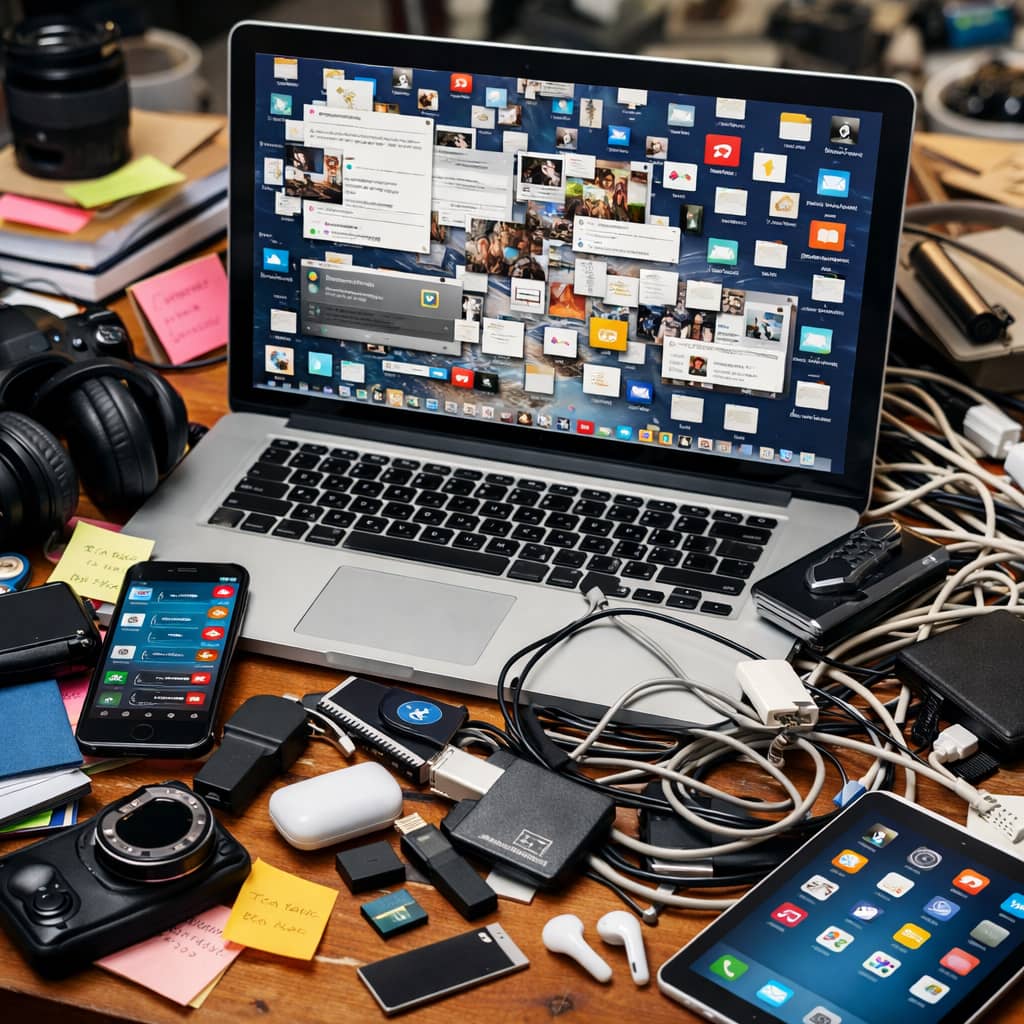
A visual metaphor of digital clutter: app icons, photos, files, and notifications
Digital clutter: the invisible pile that still takes up space—just in your attention.

Bold data strip

A few “real-world” signals that help explain why midlife feels like peak-stuff season.

Median size of new single-family homes (sq ft)

U.S. Survey of Construction time series (selected years) + 2024 highlight.

1,545
1973
1,585
1980
1,915
1990
2,057
2000
2,169
2010
2,467
2015
2,210
2024

Self-storage usage by age (percent renting)

StorageCafe survey highlights: who’s most likely to rent storage.

11%
18–23
21%
24–39
23%
40–55
21%
56–74

Average annual spending by age (USD)

Consumer Expenditure Surveys (2021): average annual expenditures by age.

$42k
Under 25
$64k
25–34
$80k
35–44
$84k
45–54
$71k
55–64
$52k
65+
Sources (for the data strip): U.S. Census Bureau, Survey of Construction (SOC) time series: square feet of floor area (median/average) (1973–2015); U.S. Census Bureau, Highlights of 2024 Characteristics of New Housing (median size of new single-family home sold in 2024); U.S. Bureau of Labor Statistics, Consumer Expenditure Surveys, 2021, Table 1300 (age of reference person); StorageCafe, self-storage usage by age group.
ClutterLogic.com | Check Us Out On Medium