Organized Clutter
- Full shelves
- Labeled bins
- Drawer dividers
- Storage furniture
Managing volume vs. reducing volume
The hidden structural difference isn’t “messy vs. tidy.” It’s how much stuff your life has to carry.
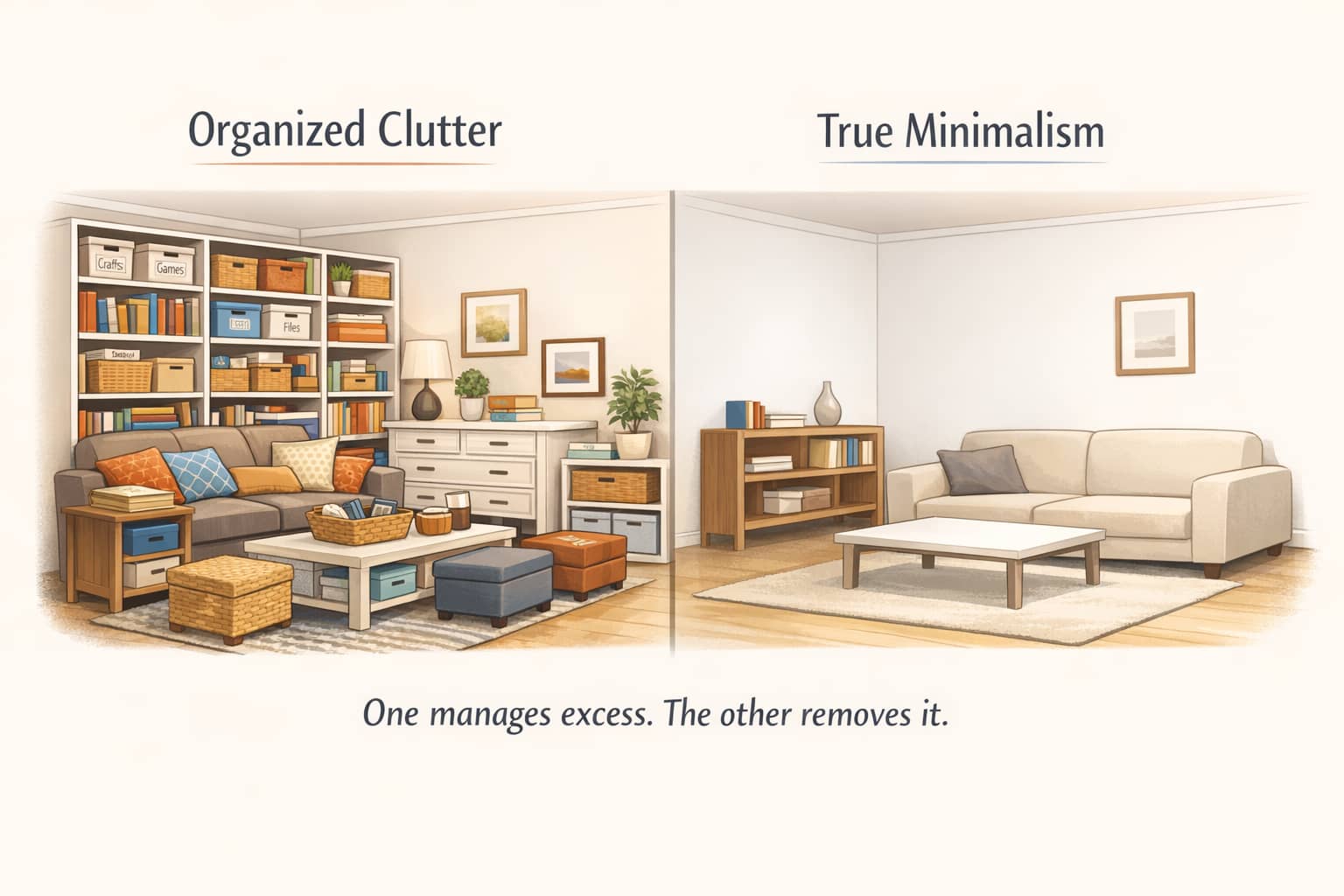
Key idea One manages excess. The other removes it.
Organizing can make high volume feel orderly. Minimalism makes high volume unnecessary.
| Factor | Organized Clutter | True Minimalism |
|---|---|---|
| Object count | High | Low |
| Storage systems | Many | Few |
| Maintenance time | Ongoing | Minimal |
| Decision fatigue | Moderate–High | Low |
| Dependency on containers | High | Low |
Organization rearranges excess.
Minimalism reduces it.
If a system only works when you keep resetting it, the problem isn’t your willpower. It’s volume.
Time you can’t see
≈ 55 hours/year
Household management & organization averages about 0.15 hours/day in U.S. time-use data.
Why it compounds
Resets scale with stuff
The more you own, the more often systems hit capacity and demand a full re-sort.
Minimalism advantage
Fewer failure points
Less inventory means less tracking, less shuffling, and fewer “where does this go?” moments.
After a certain volume, even great systems start to break. Not because you’re doing it wrong—because the curve changes.
Organizing often purchases complexity. Minimizing often removes it.
The organizing market is big for a reason.
U.S. home organizers & storage is estimated around $12.05B (2025) and projected to reach $15.21B (2030).
That doesn’t make organizing “bad.” It shows how often we try to solve a volume problem with products.
Visual noise is not the thesis here. It’s a supporting layer: more objects means more inputs to filter.
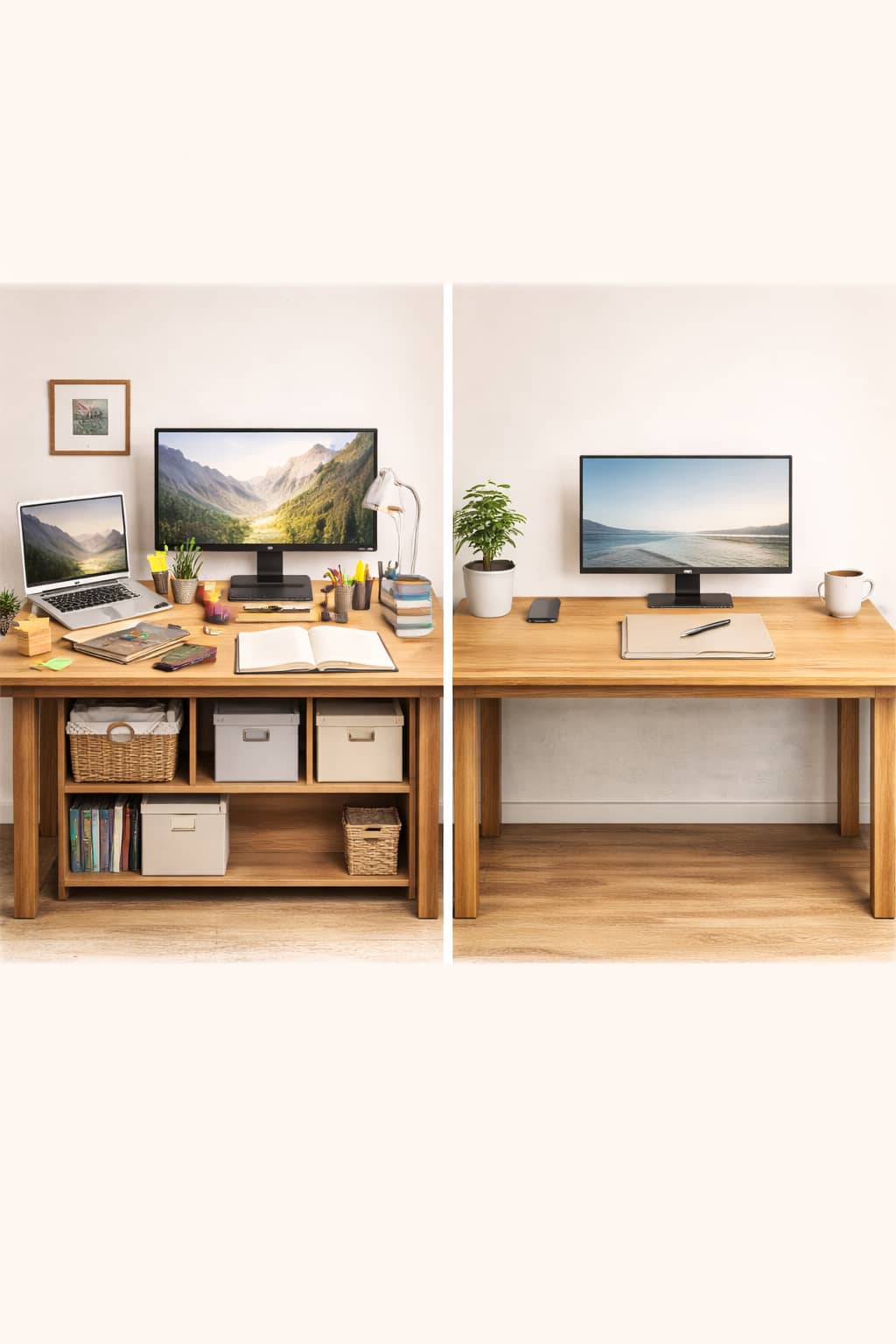
Tidy desk, many items
35 visible items
Categorized, but still tracked.
Tidy desk, few items
6 visible items
Less scanning. Fewer decisions.
Visual competition rises when many stimuli share the same space; attention has to work harder to prioritize what matters.
This isn’t a personality trait. It’s a strategy check.
→ You’re probably managing volume, not reducing it.
Try a swap: remove first, then organize what remains.
If your systems feel fragile, the most powerful upgrade usually isn’t a better bin. It’s fewer objects in the system.