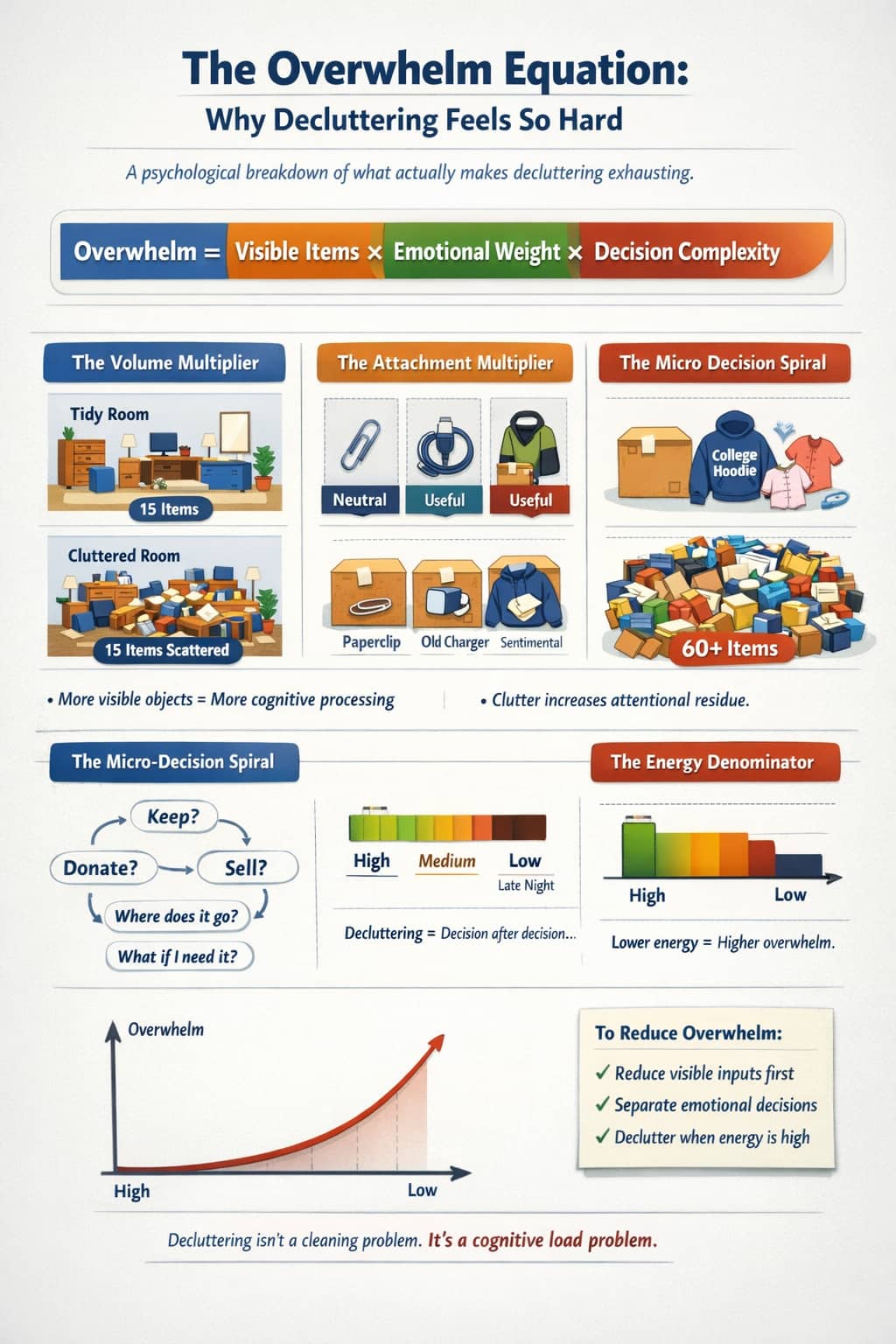
Visible Items — The Volume Multiplier
The brain keeps scanning what’s in view. Each object becomes a tiny “open loop” competing for attention.
- More visible objects = more cognitive processing.
- Clutter can create attentional residue—your mind keeps checking what’s unfinished.
- Research has linked visually cluttered environments with higher stress and reduced focus.
Make “quiet zones”
Clear one surface completely to give your eyes a rest.
Contain, don’t decide
Use a basket to collect strays—decision comes later.
Hide duplicates
Put like-with-like so your brain stops rescanning repeats.
Emotional Weight — The Attachment Multiplier
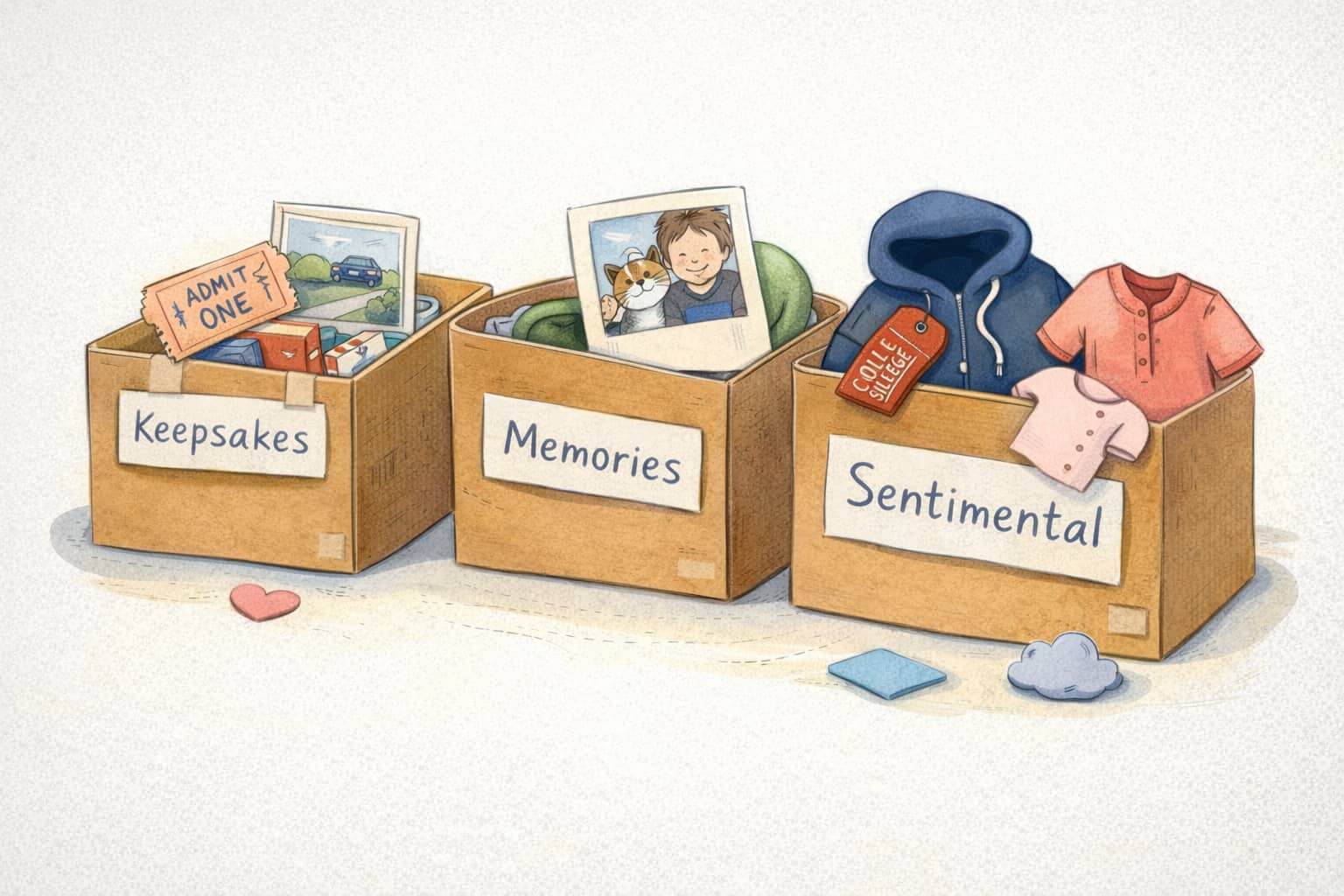
The more meaning an item carries, the more your brain resists closing the loop.
- Loss aversion: letting go can feel like losing value—even if you never use it.
- Nostalgia bias: meaning can outweigh practicality.
- Future-self projection: “What if I become the person who needs this?”
Decision Complexity — The Micro-Decision Spiral
Decluttering isn’t one decision. It’s a branching set of decisions—repeated dozens of times.
- Decision fatigue: making many small calls drains mental energy.
- Choice overload: too many “right” options can freeze action.
- Layering effect: you decide what it is, what it means, and what to do—often in one breath.
Keep + home
If you keep it, assign it a specific location now.
Release
Donate or recycle without deciding the perfect destination.
Park it
A time-boxed “review later” bin for uncertain items.
Available Energy — The Energy Denominator
Overwhelm spikes when energy drops—because the same workload is being divided by less capacity.
- Low energy doesn’t make you “less disciplined.” It makes the equation harsher.
- Energy includes sleep, stress, time pressure, and sensory load—not just motivation.
- When you’re depleted, even deciding where to put something can feel impossible.
Short sprints
10–15 minutes reduces dread and preserves energy.
One surface only
Smaller scope keeps the denominator from collapsing.
Stop at “reset”
End when the space is functional—not perfect.
The Psychological Curve — When Overwhelm Spikes
As energy drops, overwhelm rises faster—especially when items, meaning, and complexity are high.
- When energy is low: focus on reducing visible inputs (contain + reset).
- When energy is high: do the meaning-heavy decisions (sentimental items).
- When decisions branch: use fewer routes (keep, release, park).
The Reframe
Decluttering isn’t a cleaning problem.
It’s a cognitive load problem.
If overwhelm is the equation, you can change the outcome by changing the inputs—especially the ones that are easiest to adjust first.
- Reduce visible inputs first (contain, group, cover).
- Separate emotional decisions from sorting decisions.
- Declutter when energy is high—make “easy mode” your default.