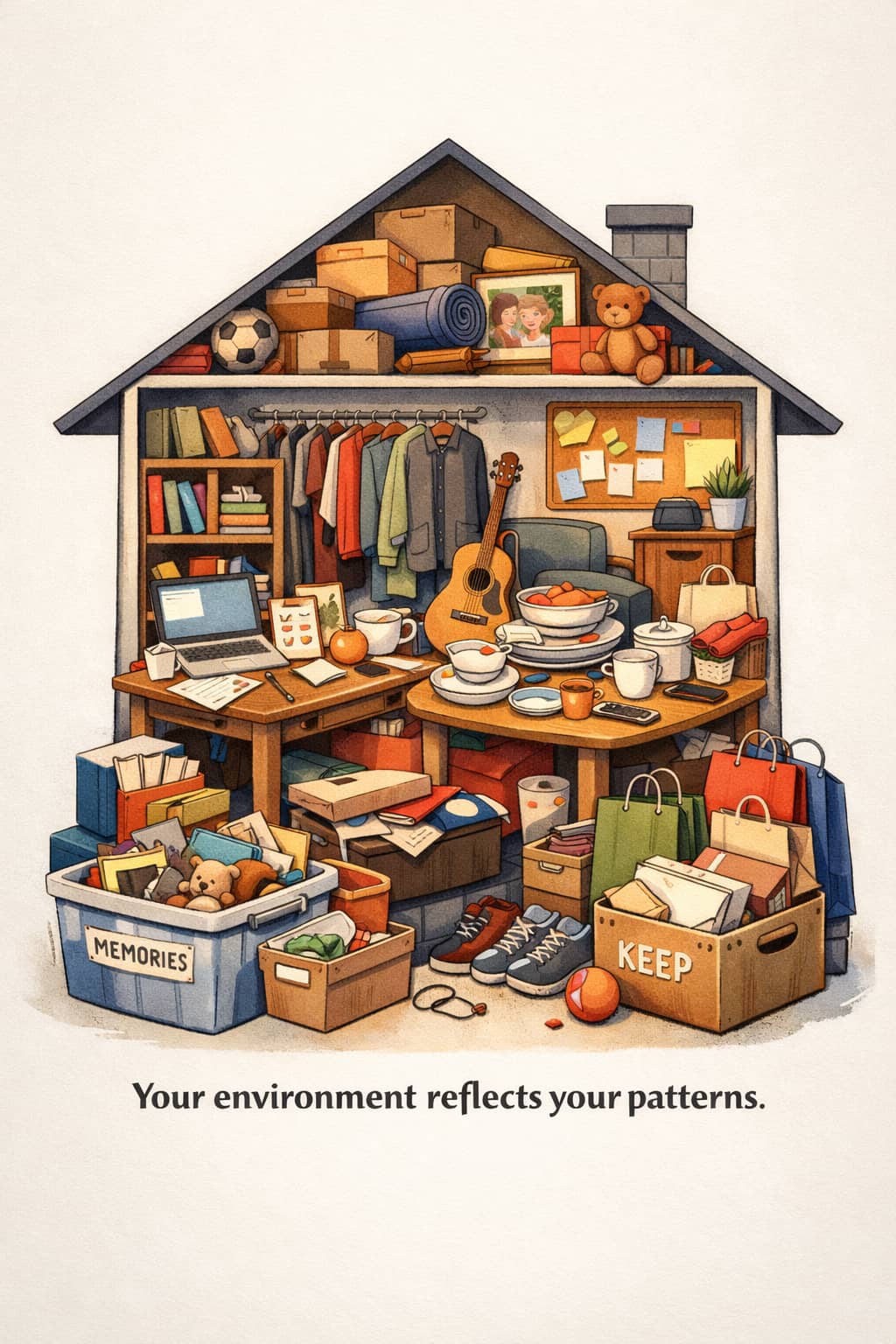
Your Space Is Behavioral Data

Reframe clutter from “mess” to “signal.”

Homes don’t become cluttered by accident. They become layered with decisions, delays, and emotional attachments. What shows up in your space can quietly reveal:

  • How you make decisions
  • What you fear losing
  • Where you feel overwhelmed
  • What identity you’re holding onto
  • How much cognitive bandwidth you have

Key line: Your environment reflects your patterns.
A simple house outline filled with layered items A calm line drawing of a house containing stacked, labeled layers that represent decisions, delays, and attachments. Decisions Delays Emotional attachments
Clutter often collects where choices stall or emotions stack.

The Entryway: What You Carry In

Shoes, bags, mail, and “just for now” piles near the door.

Common pattern

When the entry becomes a drop-zone, it usually isn’t laziness—it’s a signal of limited mental margin. The first place to overflow is often the first place you land.

May reflect

  • Decision fatigue
  • “I’ll deal with it later” momentum
  • An overextended schedule

Insight: When there’s no mental margin, physical margin disappears first.

Decluttering reframe: Create frictionless systems, not stricter rules.

The Desk or Workspace: Your Cognitive Landscape

A desktop is often a map of how you process responsibility.

Covered in unfinished tasks

Open loops → mental clutter

You may be carrying too many “active” commitments at once. When tasks stay visible, your brain keeps them running in the background.

Theme: Cognitive load

Over-organized perfectionism

Control as comfort

Structure can be soothing when life feels unpredictable. Order becomes a way to reduce uncertainty—especially under stress.

Theme: Scarcity mindset

Creative chaos

Idea generation > closure

You might work by externalizing thoughts—sketches, notes, stacks. The “mess” is a thinking tool, until it turns into friction.

Theme: External processing

Key line: Your desk reveals how you process responsibility.

The Closet: Identity in Storage

Closets hold more than fabric—they hold narratives.

Overpacked closet may suggest

  • Fear of letting go of past versions of yourself
  • Aspirational identity (future-self wardrobe)
  • Guilt about unused purchases

Theme: Identity attachment + loss aversion

Minimal closet may suggest

  • Clear self-definition
  • Decision simplification
  • Reduced identity attachment

Theme: Decision simplification

Emotional prompt: Are you keeping clothes for who you were — or who you are now?

The Storage Boxes: Deferred Decisions

Bins, boxes, and “miscellaneous” drawers often mark hesitation.

Often signals

  • Avoidance of small emotional decisions
  • Cognitive overload
  • “Not ready yet” mindset

Insight line: Storage is sometimes just delayed choice.

Name it: What decision is this box avoiding?

Shrink it: One category per box, not “misc.”

Time-box it: Give “not yet” an actual date.

Stacked boxes labeled with decision stages Three boxes stacked like a stair-step with labels: Not sure, Not now, Not mine. Not sure Not now Not mine
Clutter accumulates where decisions stall.

Surfaces: Your Tolerance for Visual Noise

Counters, tables, and nightstands show what your brain can filter.

Visual noise spectrum A gentle bar gradient with markers indicating different preferences for visual stimulation. Stimulated Balanced Calm

High surface clutter

  • Higher stimulation tolerance
  • Fast-paced life
  • External processing style

Theme: Cognitive load management

Clear surfaces

  • Lower stress tolerance for noise
  • Preference for visual calm
  • Intentional boundaries

Theme: Boundary setting

Reset idea: Choose one “clear surface” that stays clear. Let it become your nervous system’s exhale.

The Sentimental Zone: Memory vs Fear

Photo boxes, childhood items, inherited objects—where meaning concentrates.

Sentimental clutter deserves special care. It can represent memory preservation—healthy, grounding, and human. It can also become fear-based holding: a way to avoid grief, change, or the feeling of “losing” something important.

Memory preservation

Honors the past

  • Kept intentionally
  • Accessible and meaningful
  • Contained in a defined space

Fear-based holding

Avoids the feeling of loss

  • Kept by default
  • Expands into more areas
  • Creates low-grade emotional pressure

Reflective prompt: Are these items honoring memory — or protecting you from loss?

Theme: Loss aversion + avoidance coping

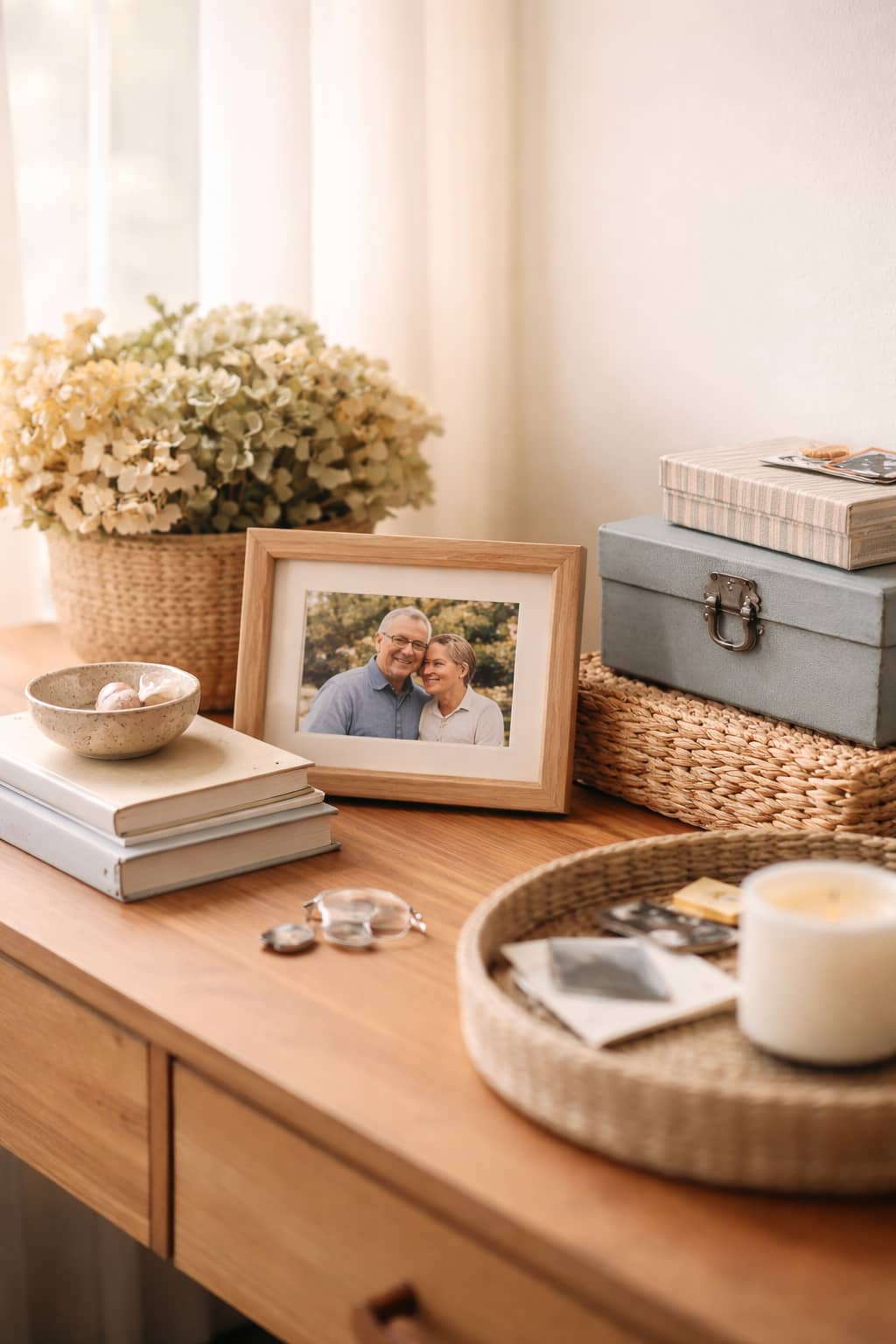
A calm, softly lit shelf with a small photo frame and a few meaningful objects, arranged with space.
Meaning feels lighter when it’s chosen and contained.

What Your Space Wants You to Notice

Bring the signals together—then reset with intention.

Your home may be showing you:

  • Where you’re overwhelmed
  • Where you’re holding onto identity
  • Where you’re avoiding decisions
  • Where you’re overextended
  • Where you’re ready for change

Decluttering isn’t about becoming minimalist.
It’s about aligning your space with your current self.

Small, honest reset

  • Pick one zone (entryway, desk, closet, boxes, surfaces, sentimental items)
  • Choose one goal: reduce friction, reduce noise, or reduce open loops
  • Make one visible change that matches your life right now