Why it keeps coming back
Decluttering is an event. Recluttering is a system. The cycle is powered by emotional triggers, short-term relief, and steady inflow.
- Emotion starts the cleanup.
- Relief makes it feel “solved.”
- Inflow makes it unsolved again.
1 Stage 1
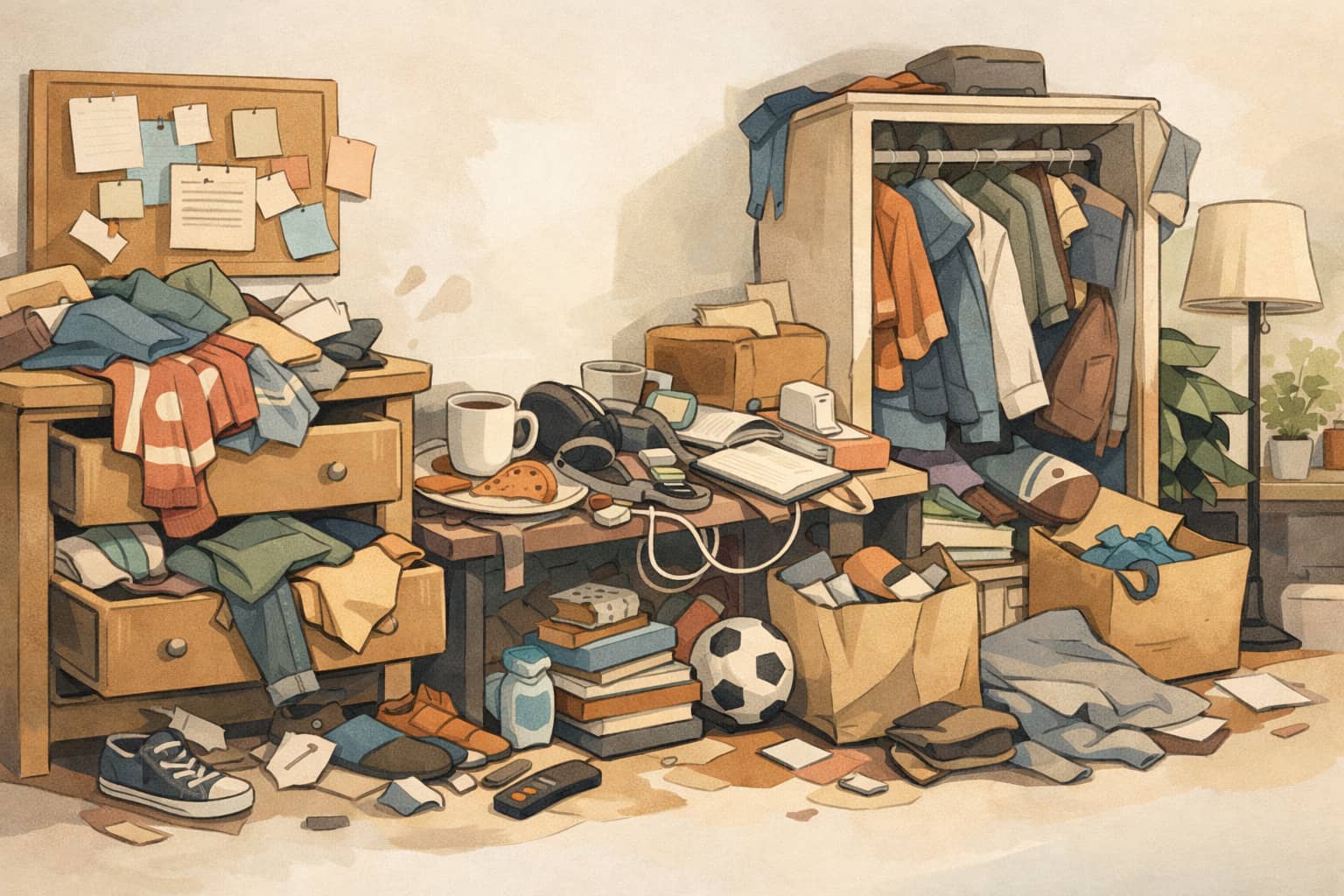
The Breaking Point
Triggered by stress, shame, or a life transition.
The inner monologue
- “I can’t find anything.”
- “I’m starting fresh.”
- “This weekend, I fix it.”
54%
reported feeling overwhelmed by clutter (national survey)
Decluttr survey (2015)
Cortisol
A “stressful home” environment has been linked with higher daily stress markers
Saxbe & Repetti (2010), UCLA
Psychology label
- Stress signal
- Shame spiral
- Life-change trigger
2 Stage 2
The Great Declutter
Relief. Control. Fresh-start energy.
What it feels like
- Fast decisions.
- Visible progress.
- “I can breathe again.”
Known bias
We overestimate how long motivation will last — especially right after a big win.
Fresh start effect
Temporal landmarks (weekends, birthdays, new years) make change feel easier — briefly.
Dai, Milkman & Riis (2014)
Emotional label
- Relief
- Control
- Fresh-start glow

3 Stage 3
The Calm Period
The house is quiet. The system looks stable.
“This time it’s different.”
What’s happening under the calm
- Rules feel effortless because friction is low.
- Identity shifts start (“I’m an organized person now”).
- Maintenance is invisible work — until it isn’t.
Psychology tag
- Optimism bias
- Identity attempt
- Low-friction phase
Tension builder
The reset worked. But the inflow system never changed.
4 Stage 4
The Drip Effect
Micro-acquisitions begin: “Just one thing…”
It doesn’t look like clutter (yet)
- Convenience buys
- Sale justification
- Replacement upgrades
- “Future self” purchases
≈167
packages per U.S. household in 2024 (about 14 per month)
Capital One Shopping research (2025 report)
~20%
of total e-commerce sales attributed to impulse buying (estimate)
Capital One Shopping research (2025 report)
Recognition moment
- Low-cost drift
- Tiny “treat” logic
- One-click frictionless

5 Stage 5
The Space Expansion Illusion
Storage creep: more containers create more “permission.”
“If I just organize it better…”
What’s really happening
- Space gets redefined as “available inventory.”
- Containers hide volume — they don’t reduce it.
- Organizing becomes concealment with nicer edges.
Behavioral concept
- Container effect
- Space-expansion bias
- Out-of-sight relief
6 Stage 6
Identity Drift
Decision fatigue + habit regression + comfort accumulation.
The signs
- One surface becomes the drop zone.
- The junk drawer reappears “temporarily.”
- Small messes stop feeling urgent — until they are.
The punch line
You didn’t fail. The loop restarted.
Psychology overlays
- Decision fatigue
- Habit regression
- Comfort objects
Relapse isn’t a character flaw. It’s what happens when the inflow system stays the same.
The Full Cycle
A predictable behavioral loop — not a personal flaw.
Reading-order recap
- Breaking Point: emotion triggers a reset.
- Great Declutter: relief creates a “solved” feeling.
- Calm Period: optimism rises; maintenance stays invisible.
- Drip Effect: steady inflow returns in tiny pieces.
- Storage Creep: containers expand, volume follows.
- Identity Drift: fatigue restores the old default.