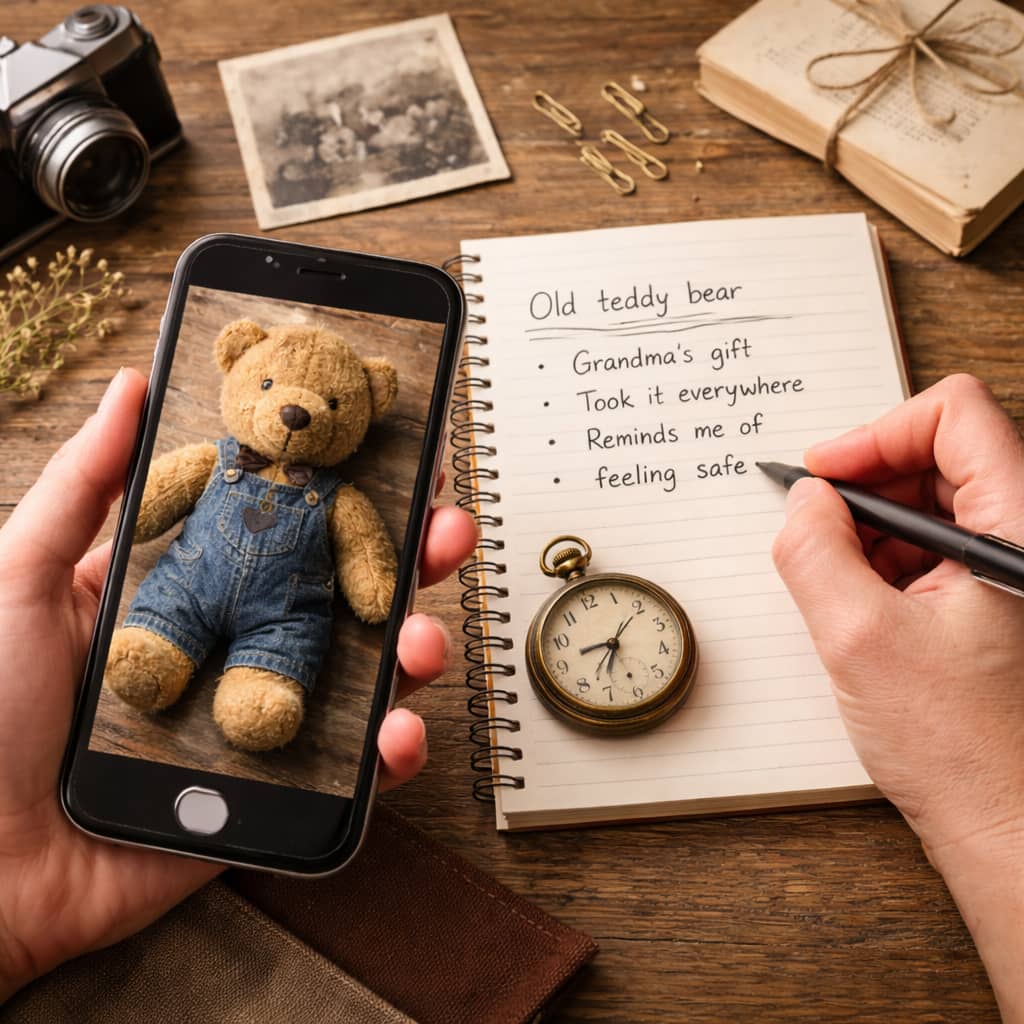
The Sentimental Clutter Decision Tree (When You Don’t Know What to Keep)
A practical, operational flowchart to answer one question:
“What do I do with this specific sentimental item?”
(No philosophy. Just next steps.)
sentimental decluttering
how to declutter sentimental items
letting go of sentimental things
decision tree decluttering
START HERE → one item

Hold one item at a time. Run it through the filters below, in order.
Your goal is a clear category—not a guilt debate.
The only question this answers
How do I decide what to do with this specific sentimental item?
The guiding rule
Start with function. Then address memory. Then handle emotion.
START
You’re holding a sentimental item.
Treat this like a tiny decision system: one object → one outcome.
Step 1
Current Function Filter
Function first.
Does this item actively support your current life?
Examples (pick the closest match):
Used weekly?
It earns its spot by being part of your routines.
Displayed intentionally?
It’s visible on purpose—not “just sitting there.”
Serves a practical role?
It solves a real need (not a theoretical one).
YES
Keep in Physical Space. End branch.
NO
Continue. This is love vs. function—function wins first pass.
Step 2
Daily Absence Test
Avoid guilt triggers.
Would you notice its absence in daily life?
Not “Would I miss it emotionally?” but:
Would removing it change how I move through my day?
YES
Integrate intentionally (display/use), or
reduce duplicates.
NO
Continue. If it doesn’t affect your day, it’s a strong candidate for release or archiving.
The object is a cue, not a container.
Your goal is to keep the meaning—without needing the object to do all the holding.
Memory extraction can be a photo, a short story, or a named meaning.
Once the memory is captured, the decision gets easier.
Step 3
Memory Extraction
Capture meaning first.
Have you extracted the memory from the object?
Any one of these counts:
Photographed it?
One clear photo (plus a close-up if needed).
Written the story?
Three sentences: what, when, why it matters.
Named what it represents?
A label like “Grandma’s care” or “First big win.”
NO
Extract memory first. Then reassess.
YES
Continue. Now you can choose based on role, not fear.
Step 4
Emotional Role Identification
What job is it doing?
What role is this item playing?
Pick the closest “job” below (it can be more than one):
Identity anchor
It represents who you are (now), not who you used to be.
Guilt placeholder
Keeping it feels like “proof” you cared (or should have).
“Just in case” reassurance
It’s a comfort object against a future you can’t predict.
Inherited obligation
It’s here because someone else expected it to be.
Proof of achievement
It’s evidence you did something hard (and survived it).
Avoided grief
Letting it go feels like reopening a loss you’ve postponed.
If the role is reassurance or guilt…
Emotional Space, not Physical Space. Keep the memory; release the object.
If the role aligns with current identity…
Intentional Display or a Contained Archive with boundaries.
Step 5
Final Categorization
Choose one box.
Where does this item belong now?
Pick the outcome that matches the filters above. Clean categories. No minimalism extremism required.
A. Physical Space
KEEP
- Supports present life
- Used or displayed intentionally
- Has a clear “home” (not a pile)
B. Emotional Space
RELEASE
- Memory retained
- Object released
- Guilt/reassurance handled without storage
C. Contained Archive
BOUNDARIES
- Limited box
- Defined boundaries
- Finite capacity (when full, reassess)